

Cape Girardeau, Missouri, played a significant role in the Civil War, with Union and Confederate forces clashing in the area during the Battle of Cape Girardeau on April 26, 1863. This self-guided driving tour takes you through the key sites and monuments that remember the sacrifices and struggles of that time.
Follow this route to explore the historic landmarks where soldiers fought, generals strategized, and communities were forever changed by the war.
Stop 1: Mississippi Waterfront

Start your journey downtown at the Mississippi River floodwall on Water Street. This was a busy hub during the Civil War, with steamboats docked and a ferry crossing the river. On the southwest corner, you’ll find the Port Cape Girardeau restaurant, housed in one of the oldest buildings in the city. It is believed that Ulysses S. Grant used this structure as a headquarters during his brief stay in Cape Girardeau before moving to Cairo, Illinois. From this spot, additional Union troops arrived during the Battle of Cape Girardeau, though their reinforcements were ultimately unnecessary.
Stop 2: Courthouse Park
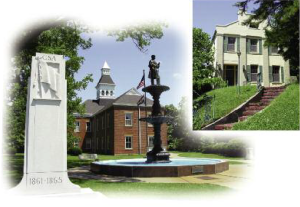
Walk west on Themis Street and make your way toward Courthouse Park, home to the Common Pleas Courthouse, Confederate Memorial, and Union Memorial. The courthouse, built in 1854, served as Union headquarters, with its basement used to detain Confederate soldiers. The park’s monuments honor soldiers from both sides of the war. Take in the view from the courthouse steps, where history resonates with stories of confrontation, including a heated exchange between Generals Grant and Prentiss.
Stop 3: Old Lorimier Cemetery
Next, head to Old Lorimier Cemetery, established in 1808 by Cape Girardeau’s founder, Pierre Louis Lorimier. The cemetery is the final resting place for many Civil War soldiers, some buried in unmarked graves. Nearby, the Minton House, once a smallpox hospital during the war, adds to the somber history of this location. Take a moment to reflect on the personal tragedies the war brought to this community, where many mothers grieved sons who never returned home.
Stop 4: Fort B
Continue your tour to the site of Fort B, located on the campus of Southeast Missouri State University. This fort played a crucial role in defending Cape Girardeau during the battle, equipped with howitzers and siege guns that commanded a clear view of the surrounding area. It was here that Union forces fired upon advancing Confederate troops, preventing them from breaching the city’s defenses.
Stop 5: Federal Right Flank
Drive to the high ground near Perry Avenue, where Union forces, including the 1st Nebraska Infantry and 32nd Iowa Infantry, held their position during the Battle of Cape Girardeau. From this vantage point, the Federal right flank controlled key approaches to the city. Across the valley lies New Lorimier Cemetery, where Confederate forces once arrayed their battle line.
Stop 6: Battle of Cape Girardeau Monument
On Broadway, you’ll find a small monument marking the site of the Battle of Cape Girardeau. From this point, you can imagine the Confederate and Union forces locked in an artillery duel that ultimately ended in a Union victory. The Confederate artillery withdrew under heavy fire, signaling the beginning of their retreat from the area.
Stop 7: Fort C
Make your way to Ellis Street, where the site of Fort C is commemorated. This fort, with its large cannons, controlled the Bloomfield Road approach to the city. During the battle, Union forces here effectively deterred Confederate advances, and the fort’s strategic location ensured the safety of Cape Girardeau’s southern defenses.
Stop 8: Fort D

Your final military stop is Fort D, constructed in 1861 to defend the river approaches to Cape Girardeau. Unlike the other forts, Fort D never saw action during the battle but served as a stronghold and deterrent against Confederate forces. The site remains well-preserved today, offering a glimpse into Civil War military architecture.
Stop 9: St. Vincent’s Seminary
Complete your tour at St. Vincent’s Seminary, founded before the war in 1854. Located on the River Campus of Southeast Missouri State University, the seminary offers a scenic view of the Mississippi River.
This tour of Cape Girardeau’s Civil War sites takes you through the heart of a city deeply impacted by the conflict.
From the battlefields to the cemeteries, the forts to the courthouses, each stop along the way tells the story of a divided nation and a community forever changed by the events that took place during the war.